In most industries, leaders put up barriers when they see someone from outside their industry looking in. Whether hiring workers, consultants, trainers, managers or engineers, they put the blinders on and look for someone who has done that particular job before.
When thinking lean, we explore how we do the work. We break tasks out to discover what skills are required, what equipment is required, what tools are required, what material is required, what information is required. We look at how all of this fits together to create flow. Where we can’t flow, we introduce pull. We level out the work and install visual queues to see where the problems are. We engage people in fixing the system.
In doing all of this, it does not matter if he are building cars, treating patients, making ice cream, digging coal, making paper, designing spaceships, building skyscrapers or making vaccine.
Every task in any business can be broken down into a system. Lean thinking is applied to the system. We work on how we do the work and eliminate waste in the process. Lean is all about continuously improving the system to deliver customer value.
More companies should realize that while they are “unique” in what they do, they are simply using systems and processes to create value for the customer. Hiring someone who has a systems background and understands lean thinking can be a huge asset to any organization. Put these people to work!
Norm
www.normanbain.com
Showing posts with label Change Management. Show all posts
Showing posts with label Change Management. Show all posts
Friday, January 8, 2010


Thursday, January 7, 2010
Standard work for leaders
One the fundamentals of lean is the concept of standard work. Where there is no standard work, there can be no kaizen. Kaizen roughly translates to “change for the good”. But our people must establish, agree on, and become proficient at the current method before they can improve it.
Its fine to ask our newest people to raise the flag and ask “why” we are doing things a certain way. But if everyone does things differently, how do we make any improvement at all? The answer is to adopt a standard way, then improve on it. Our peoples job is to do the work and to improve the work.
Have you looked at standard work for supervisors, for managers, for team leaders? Perhaps if we adopt standard work for our leaders, our improvement initiatives will be smoother. What is it that our leaders should do every day to help us succeed? How do we know they are doing it?
The links below are some templates for thought starters. I’d be pleased to hear your success stories with leader standard work!
Team Leader Standard Work
Supervisor Standard Work
Norm
www.normanbain.com
Wednesday, December 30, 2009
Recognizing a Lean Organization
First impressions are lasting! When I walk into your organization, what impression will you leave? What story do your people tell? What message do they send? Does the story and message align? Do you walk the talk?
Lean organizations never fail to impress me. From the wait time at reception, through the safety orientation and the facility walk through, these organizations have their act together. It’s about caring for people and the total customer experience. Whether the visitor is a customer, a prospective employee, or a tourist, you only have one chance to make that first impression.
What do I notice and look for during that first walk through at a facility? What are the indications that this company has their act together and is on their way to becoming a lean enterprise?
Here is a short list of some tell tale signs;
• Clear signage to guide me through the lot and the visitor parking area to reception.
• The kaizen award parking stall designation near the front door.
• The absence of designated parking by position or status in the organization.
• A friendly greeting by reception, a smile that indicates they enjoy being part of the team and a wait time commitment that reflects respect for me and my time.
• A simple mission, vision and values statement that aligns with posted community involvement and engagement initiatives.
• Transfer of that mission and vision to a posted true north dashboard once inside.
• Communication boards that are current and relevant.
• Team engagement and recognition, photos of team members and success delivered by CI teams.
• Visual display boards at work centers highlighting what takes priority today.
• Work centers arranged to optimize flow.
• Visual indicators for wayfinding, process flow, inventory control and WIP management.
• Stoplight controls for problem awareness and designation of ownership and accountability (who is doing what by when)
• Standard work procedures that are posted.
• Cross training, demonstrated skills and abilities matrix by station.
• Takt time, cycle time and deviation correction indications.
• 5Y problem solving and CI initiatives by workstation.
• A lack of cupboards, drawers and closets to “hide” clutter.
• Batch size and material movement methods.
• An indication that equipment is cleaned and inspected regularly.
• A workforce that is engaged and enthused about their work and the organization. A work team that talks about what they are doing to improve
As I dig deeper into the organization with the leadership, we’ll discuss their metrics, how they are becoming a learning organization and the initiatives underway to build and maintain the culture they envision. We’ll discuss their vision for the future, the coming months and how they are transforming that vision to an action plan for strategic deployment.
In a lean enterprise, I rarely hear “it won’t work here” or “I’ve been meaning to try that”. It seems that excuses get replaced by actions in the world of lean. And that energy is contagious!
Norm
www.normanbain.com
Monday, December 14, 2009
Make things happen
Just read an interesting post by Gina Trapani who blogs at http://smarterware.org/ that I thought I'd share here. It speaks to the heart of focused change.
Getting things done is not the same as making things happen.
You can…
…reply to email.
…pay the bills.
…cross off to-do’s.
…fulfill your obligation.
…repeat what you heard.
…go with the flow.
…anticipate roadblocks.
…aim for “good enough.”
Or you can…
…organize a community.
…take a risk.
…set ambitious goals.
…give more than you take.
…change perceptions.
…forge a new path.
…create possibility.
…demand excellence.
Don’t worry too much about getting things done.
Make things happen.
Norm
www.normanbain.com
Tuesday, December 8, 2009
Strategy and Approach to Value Stream Mapping
What is Value Stream Mapping?
All businesses consist of processes. Processes for purchasing materials, receiving materials, storing materials, modifying materials, making parts, moving parts, assembling parts, packaging parts, verifying parts, shipping parts, creating invoices, receiving payments, keeping score, recruiting talent, rewarding talent, training talent ... the list as endless as the imagination and complexity of the organization.
However, many of these processes do not add value for the customer.
The customer is defined as the person who uses your product or service. Your customer may not particularly care if you have a harassment policy and have everyone trained in its application. Your customer may not see value in the time your team spends waiting for instruction or searching for tools. We can all identify several activities that, if viewed through our customers eyes, would not be considered adding value.
To be considered value added, the activity must meet three conditions; (1) it must be something that the customer would be willing to pay for, (2) it must change the “thing” as it moves through the process, and (3) it must be done right the first time. Rework in any form does not add value.
Value stream mapping looks at the flow of product through your entire process and links together the steps that add value. At each of these steps we determine who is involved involved, the time it takes, the value added time it takes, the inventory of parts and product on hand, the signals and instruction that tell us what and when to build.
A value stream map displays a picture of how material and instructions move product through a value stream. So the first step in creating a value stream map, is identifying the value stream. What product, or family of products are we trying to map?
Key things to consider; What products share common processes? Where does the value stream start and end (order entry to shipment)? Are there optional processes? Does everyone on every shift perform the tasks in the same sequence, using the same equipment and the same procedure? Have we asked the people currently doing the work if this is how they really do it today?
Once the map is complete, it will clearly show how long it takes material to flow through the value stream (our lead time) and some opportunities for improvement will become apparent.
A value stream mapping exercise typically starts with a “scoping exercise”. This exercise looks at each step in the process and identifies;
(1) What is the main activity at this step? What comes in and what goes out?
(2) How long does it take (best time, worst time, average time)?
(3) How much of that time is adding value?
(4) What materials are required, how much do we have, how much do we need?
(5) What is our cue to do work (a schedule, an empty shelf, supervisory instruction)?
(6) How long does it take to set up the equipment/job?
(7) How do we move material into the station and out of the station? What is the cue to move?
To complete the scoping exercise, someone who is familiar with the work performed at this step needs to be present.
Once we have completed the scoping exercise, others working in the area should review the result to ensure nothing was missed or overlooked.
Once each step in the value stream has been identified and documented in the scoping exercise, we can transfer this information to a value stream map. The map will present a picture of how our value steam functions and give some insight into how the process can be improved.
The following steps are required in value stream mapping:
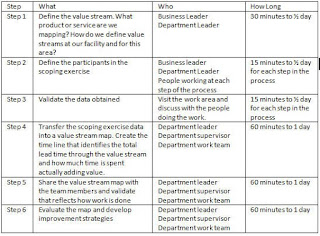
The value stream mapping exercise will clearly show where problems/opportunities exist with material and communication flow through the facility. The leadership of the area along with the work team can use this information to formulate an improvement strategy to improve this flow through the value stream.
Value stream mapping is a powerful tool to provide insight to value stream throughput improvement.
Norm
www.normanbain.com
All businesses consist of processes. Processes for purchasing materials, receiving materials, storing materials, modifying materials, making parts, moving parts, assembling parts, packaging parts, verifying parts, shipping parts, creating invoices, receiving payments, keeping score, recruiting talent, rewarding talent, training talent ... the list as endless as the imagination and complexity of the organization.
However, many of these processes do not add value for the customer.
The customer is defined as the person who uses your product or service. Your customer may not particularly care if you have a harassment policy and have everyone trained in its application. Your customer may not see value in the time your team spends waiting for instruction or searching for tools. We can all identify several activities that, if viewed through our customers eyes, would not be considered adding value.
To be considered value added, the activity must meet three conditions; (1) it must be something that the customer would be willing to pay for, (2) it must change the “thing” as it moves through the process, and (3) it must be done right the first time. Rework in any form does not add value.
Value stream mapping looks at the flow of product through your entire process and links together the steps that add value. At each of these steps we determine who is involved involved, the time it takes, the value added time it takes, the inventory of parts and product on hand, the signals and instruction that tell us what and when to build.
A value stream map displays a picture of how material and instructions move product through a value stream. So the first step in creating a value stream map, is identifying the value stream. What product, or family of products are we trying to map?
Key things to consider; What products share common processes? Where does the value stream start and end (order entry to shipment)? Are there optional processes? Does everyone on every shift perform the tasks in the same sequence, using the same equipment and the same procedure? Have we asked the people currently doing the work if this is how they really do it today?
Once the map is complete, it will clearly show how long it takes material to flow through the value stream (our lead time) and some opportunities for improvement will become apparent.
A value stream mapping exercise typically starts with a “scoping exercise”. This exercise looks at each step in the process and identifies;
(1) What is the main activity at this step? What comes in and what goes out?
(2) How long does it take (best time, worst time, average time)?
(3) How much of that time is adding value?
(4) What materials are required, how much do we have, how much do we need?
(5) What is our cue to do work (a schedule, an empty shelf, supervisory instruction)?
(6) How long does it take to set up the equipment/job?
(7) How do we move material into the station and out of the station? What is the cue to move?
To complete the scoping exercise, someone who is familiar with the work performed at this step needs to be present.
Once we have completed the scoping exercise, others working in the area should review the result to ensure nothing was missed or overlooked.
Once each step in the value stream has been identified and documented in the scoping exercise, we can transfer this information to a value stream map. The map will present a picture of how our value steam functions and give some insight into how the process can be improved.
The following steps are required in value stream mapping:

The value stream mapping exercise will clearly show where problems/opportunities exist with material and communication flow through the facility. The leadership of the area along with the work team can use this information to formulate an improvement strategy to improve this flow through the value stream.
Value stream mapping is a powerful tool to provide insight to value stream throughput improvement.
Norm
www.normanbain.com
Monday, November 16, 2009
Changing Behaviour
I have been challenged with involvement and compliance in an office waste reduction initiative. In our self assessment study, we identified that meetings and emails demanded 20% of our office workers week. The same self-assessment indicated that 78% of the time for emails and 57% of the time spent in meetings was considered wasted by those who participated.
Regardless of this result, people working in the office were reluctant to rate themselves and provide feedback to each other on what they considered wasteful and how to improve. Third party audits are snapshots in time - we are looking for ways to engage and change the office culture to eliminate waste.
I ran across an interesting approach taken by Barnes-Jewish St. Peters Hospital (BJSPH) in St. Peters, MO. If you have been struggling with the carrot/stick approach to changing behaviour, their model may be of interest. Click here for their approach.
Anyone seeing the results of our self assessment agrees that we are on the right track. What is your experience in changing behaviour to support "doing the right thing".
Norm
www.normanbain.com
Monday, November 2, 2009
Trust, Respect and Integrity
People say you can't do business with friends and family. They strongly caution against it. They say it is a recipe for disaster.
I say this is a fallacy. My business is built on relationships. The majority of my business comes through my network of contacts. Through the business relationship we become friends and referrals follow. The key is mutual Trust, Respect and Integrity.
I've been doing a great deal of work on the topic of Lean Communication. Through my association with OEM Consultants, I have been working with groups to understand and build on this model of 100% trust and 100% respect. While I'm discovering this communication model, I'm learning that lean communication is not easy or simple. Its tough to communicate clearly, with few words and no assumptions. I know what happens when I assume things ... I make an ASS of U and ME. Yet assumptions continue to be prevalent in my life and my discussions, as I'm sure you experience in yours.
I was taught that trust and respect is earned. I preached that mindset to my kids. My professional experience has shown that there are people who will benefit from my action and ideas to my own detriment. I've discovered that this belief is one reason why change is resisted in organizations. Who will get the credit? I've also learned that this is not the norm. Most do not react this way.
If you are building a team that will effect change in an organization, you must understand the organizational culture. You must build accountability into the team. And that demands mutual trust, respect and accountability.
I started my career in management when teams were all the rage. Individual effort was ignored and individual recognition was discouraged. There is no "I" in "Team". I began to speak in terms of we, rather that I. So much so, that I once had a recruiter ask me exactly what my involvement was in an important improvement project I was describing. I had led the project and driven the results, but had been programmed to talk in terms of "we", not "I".
Times have changed. We live in an age of perceived "entitlement". People tend to think the world owes them something, yet they are not accountable for anything. Perhaps we lost that accountability by focusing on teams. Who, exactly, is "we" when the team work is not done.
There may not be an "I" in team, but there is a "me" if you look for it. Part of lean communication is understanding my responsibility, accepting that responsibility and being accountable for delivering in my role on the team.
I'm coming to understand that lean communication may be the foundation for lean thinking. If we can communicate more effectively, we drive out waste. That is a key principal in lean thinking. And lean thinking can be applied to manufacturing, health care, offices, design houses or any business model.
Lean communication starts on a foundation of trust and respect. Without trust and respect we lose accountability. We lose integrity. And without accountability and integrity we miss the results. So becoming a practitioner of lean communication my be a great foundation to becoming a lean organization.
This foundation of trust, respect and integrity is what makes friendships and family work so well. We don't betray that foundation with family or friends. So why do we in business?
If you would like to learn more about lean communications, contact George at OEM Consultants. Its a different approach. I'm finding it effective. I think its fascinating. I have a lot to learn before I become a lean communicator.
Norm
www.normanbain.com
For more information, see my post on Leadership and Self Deception
Friday, October 16, 2009
Lean Product Development
Thinking Lean is usually associated with manufacturing processes. Many people lose sight of how to apply lean concepts outside the manufacturing plant floor. Articles and case studies are readily available to assist someone starting their lean journey in manufacturing. Not so much is available for those in office environments, accounting departments, engineering teams or in service industries like health care.
While this blog post is geared toward lean product development (concept, design, engineering, production readiness), it applies to lean thinking in many venues. It may provide some insight on how to approach your lean journey.
How would you feel if you reduced your product design cycle by 50%. Kudos all around! How would you react if you were tasked by your boss to deliver your next design project to the market in half the time. How would you approach this challenge? These are the results that design teams are achieving through lean product development. Read on to discover how you can apply these tools in your facility.
In applying lean to the product development process, there are six key issues to explore; focus, clarity, alignment, ideation, WIFM and strategy. We’ll briefly explore each.
Focus
Lean thinking demands we develop our skill in identifying and eliminating waste. We focus our effort on the value stream – the things that provide value for our customer. In office environments, waste manifests itself in several forms. The two most common are distractions and lack of coordination.
Distractions come in the form of interruptions. People requiring assistance, problems that arise, email and spam, letters and correspondence. Each of these place demands on our time – and the result is time, our most precious resource, is wasted. Consistently, in time studies, 60-70% of our day is spent on activities that do not add value to the customer in the product development process. We’re too busy fighting fires.
Lack of coordination translates directly to rework. Priorities change, steps are missed, specifications change, the customer requirements shift. Typically meetings are twice as long as they need to be and have the wrong people at the table. Several people in a typical meeting room do not contribute to the discussion and distract others by texting away on their blackberries. The people who should be in the room are too busy to show up and do not send updates or designates. Meetings don’t start on time and consistently run overtime.
In fact, the first step in improving lead time for product development is waste elimination through time management and communication. Meeting rules, email rules, 5S for the office cubicle, standup coordination meetings and dedicated time for project work are a good place to start.
Clarity
The workplace is a social experience. Many people love to tell stories and debate trivial or low priority points or tasks. Some people spend more time figuring out how not to do something than it would take to just get it done.
Communication in all forms should be clear, concise and to the point. Verification that the intended message was received and understood is essential. The social media site Twitter is a lesson in showing us how to be concise. Summarize your message in just a few lines, and link me to more information if I need it. Tell your story in the subject line of your email – then I don’t even have to open it! When we get good at shortening our message, we don’t have to use the kids acronym language to convey our message. We just become more thoughtful and concise – we think about the customer, the reader, and how they will interpret our message.
Developing lean communication skills should become a priority for your team – and like any skill it must be learned and developed through practice. Develop a safe feedback method to identify and correct team member undesired behaviour and provide tools for your team to measure progress as they improve.
Alignment
In many organizations the structure of the design team itself leads to inefficiencies. Most designers have several bosses and many projects underway simultaneously. While most of us believe we are good multi-taskers, in reality few of us are. We struggle to move each project forward at the same time and all projects are delayed as a result. Traditional design houses are organized by function. This creates its own problems with islands of expertise – similar to departments in manufacturing. Ideally, the organization should be re-arranged by value stream (work flow through cells). In practice, a matrix organization typically develops and this creates its own unique challenges.
Utilize visual management tools focussed on project deliverables to align your team. Toyota’s Oobeya (the big project room) is a great model for this. While many companies do not have the resources to create this type of focussed room, the tools of this model can be readily applied. Use the lean moto “borrow with pride” or “steal shamelessly”. Where you see a good idea that will make you more effective – use it!
Oobeya starts with a model, a visual representation of what we are building to ground the team, focus on the customer and facilitate Quick Problem Solving (QPS). Out of the model flows a graphic representation of the project objectives with links to the corporate strategy or larger project plan. From the objectives, the expected outcomes are displayed and reported along with any urgent issues. From the expected outcomes, the team develops metrics to measure performance and report progress using a Red/Green stoplight approach. Quality, cost and project timing are all included so the team gets a full picture of project status. Next to the metrics, a project schedule defines deliverables by department. This is broken down on a decomposition board to schedule items requiring urgent attention more closely. Issues are clearly posted, whether they are potential or real and the resolution is displayed for communication of lessons learned. From the issues board, an escalated items area is dedicated to issues that require involvement from outside the team, typically decisions by management. The room reads like a storyboard and tells the story at a glance of how the project is progressing as well as how the team is identifying and dealing with issues.
Adopting just a few of these visual tools in your project area will help align your team and smooth the work flow.
What’s In It For Me (WIFM)
Surprisingly, for people not regularly exposed to design teams and engineering professionals, accountability can be a real problem. As professionals we think we know how to manage our projects effectively and do not react well to feedback on performance. Managers tend to step back and let the team work the black box magic that it takes to create the design. Delays and missed project milestones result.
So how do we instil accountability in an organization? Typically, it starts with clarification of roles and responsibilities. Everyone must understand what they are responsible for in terms of expertise, deliverables and timelines. The players themselves must determine how they are going to approach and deliver their tasks on time. The leader asks questions to assure themselves that the expertise and approach will deliver the desired result. Ease off the questioning and pressure as they “get it” and provide positive feedback as results are delivered. This coaching approach will instil accountability and earned trust in the organization.
Transforming the culture of an organization is a never ending and primary task for the leadership. Re-enforcing desired behaviour through constructive feedback is key. If you have read Leadership and Self Deception (Berrett-Koehler Publishers) you will identify with being “out of the box” when you do this to be effective.
Ideation
Ideation is the process for forming ideas or images. Using lean visual management and story boards in the product development area to generate and capture ideas, solutions and improvements will yield surprising results. The creativity and collaboration possible with visual problem solving continues to amaze me. When used with creative teams, the results are impressive. Get out of the cubicle and get some group think happening.
Approach
So what is the approach to implementing lean product development? Where do I start?
Lean’s PDCA cycle is a great model to follow. Start with an assessment of where you are – how lean are you and what are the wastes. A day in the life of your team member is a great place to start.
Once the status of lean in your group has been established, identify the top wastes to be addressed and provide an introductory orientation/training session for the team. Starting with lean communications is appropriate in most design teams.
As you implement the corrective action ideas, pay close attention to what the team is saying. This will give you clues of where to dig for more wastes. Have the team validate and prioritize your list and you have their commitment to proceed with implementation.
Continue this Plan-Do-Check-Act cycle and you’ll soon be mapping processes, validating data and becoming lean.
Learning as you go is the best way. Lean is a journey, not a destination.
Norm
www.normanbain.com
Wednesday, October 14, 2009
Business problems show up as inventory
Have you heard the business axiom "business problems show up as inventory"?
Whether you count inventory as WIP, raw materials or finished goods, the health of your organization is generally apparent in the level of inventory on hand. Many companies recognize this simple truth and adopt a goal to reduce inventories. The senior leadership typically sets a target for a 20% inventory reduction. Most companies typically carry 30-40% more inventory than they need to.
But without effective tools to identify excess inventory and properly manage it, most companies fail to achieve and, more importantly, sustain this inventory reduction goal. The impact of poor sales and operations planning, poor scheduling, engineering changes, material shortages, long lead times and cycle times, batching and large order quantities, overzealous buying and early material receipts are often blamed as causes for excess inventory. Without a structured approach, sustained inventory optimization is difficult to achieve.
Many companies have applied ABC categorization of inventory. This time tested approach states that by paying attention to a small percentage of line items in your inventory (20%), you can manage the lion's share (80%) of your inventory value. Most MRP systems are based on this premise.
The next step in achieving inventory reduction (as a focussed initiative unto itself) is to use the IQR methodology. Inventory Quality Ratio (IQR) is a ratio of your high moving items to the total inventory value. This is typically 30-40% in most companies. By further categorizing your inventory into active, excess, slow moving and non-moving inventory, you can improve this quality ratio enormously - typically identifying, achieving and sustaining a 30% reduction in inventory on hand.
While Lean Thinking as a strategy will yield impressive results in WIP and inventory reduction, the results can take from 6 to 18 months to see. Using IQR as a tool for rapid inventory reduction deployment, expect to see step change results in 3-6 months. Contact us for more details.
Norm
www.normanbain.com
Friday, August 21, 2009
Lean waste elimination fails to hit the bottom line numbers
Many companies, embracing the concepts of lean thinking, hear the urging to 'Just do it', in the spirit of the leaders and pioneers of the Toyota Production System. They then excitedly delve into the transformation process. They stage a kickoff meeting to share their passion, pick something important and start removing waste quickly to capitalize on that “low hanging fruit”.
The target area becomes a beehive of activity, kaizen events, continuous improvement blitzes, 5S initiatives and production tracking boards. People get engaged in the process improvements and the staff gains some hope that finally the company is listening to what they are saying.
Yet flow through the facility does not consistently improve, the mounds of in process inventory do not reduce, and expediting hot orders remains the norm. No cost savings reach the bottom line, there is no demonstrable service and quality improvement for the customer. The improvements are not sustainable. Processes drift back to the old ways of doing things.
So management reaches the conclusion that lean does not work in this environment. We are “different” and the principals must not apply in this industry. We cannot demonstrate a return on our investment.
This lean offensive with its disappointing result drifts off as another abandoned program.
So why does this happen? Why do the concepts of lean, that seem to be such common sense, not work when we apply them? How can so much information be readily available about this approach to process improvement, yet it is so incredibly difficult to implement with concrete demonstrable results?
Click here to read the rest of this article and explore the answer to this all too common dilemma
Norm
www.normanbain.com
Tuesday, August 18, 2009
Creating a Sense of Urgency Among Employees
John Ryan of the Center for Creative Leadership posted an article this week on Creating a Sense of Urgency Among Employees.
In it he talks about:
• Don't take your foot off the gas.
• Don't hesitate to share bad news.
• Convey optimism and passion.
• Publicly praise urgent actions.
• Partner with colleagues on strategy.
Great thoughts from a great organization. Read the post here.
I had the pleasure of attending the Center for Creative Leadership LDP program early in my career. It was a great experience - good people, great advice!
Norm
www.normanbain.com
Thursday, July 16, 2009
A Lean Roadmap - where do we start?
I'm often asked what a typical lean journey looks like and how long it takes to become a lean organization. While the answer to those questions is as varied as the organizations that ask it, this post will explore the most successful and repeatable approach that I have been engaged with. If you would like a copy of this post as a downloadable PDF, click here.
Step 1 Create the environment
The concepts of lean and the thinking behind lean can seem quite foreign to traditional organizations. Thinking, approach and activities must be changed, sometimes dramatically. This is often referred to as the "culture" of the organization. Lean requires a collaborative, team oriented, customer focussed and systematic approach. This shift may appear threatening to people. Fear of change is real and usually unspoken. Often, a compelling driver for change is required - an "oh-shit" experience that instils a sense of urgency with the team. This could be the loss of a major customer, a competitor challenge, or a downturn in the economic climate similar to what we are currently experiencing. This "pain" can be a strong driver to explore new ways to do things and make your world a better place. Linking lean to the global organizational strategy is a winning approach. Top management must support the initiative and communicate global measures for success. It is important to assure people that they will not lose their jobs directly because of the lean initiative. Respect for people is a lean fundamental. People are a key part of the system.
Step 2 Introduce basic concepts
This may start with a benchmarking visit to see how other organizations do things. It may start with a seminar or conference. Or you may invite someone to your site for introductory training. Exploring how others have applied lean ideas and how these can transfer into your own organization is a key concept in lean thinking. Learning from the experience of others is key - you cannot afford (in terms of both time and money) to make all the same mistakes yourself. Some formal introductory training for your team to develop an understanding of the supply chain and your value stream usually follows. The language of lean and introduction to the terms so that they are widely recognized follows.
Step 3 Manage Visually
The internet revolution and our fascination with technology has led many of us away from managing visually. In our quest to have dashboards and KPI information on our desktop, we stop visiting the gemba - where the work is done. Lean visual management requires that we can see at a glance in the workstation what is working well, what is not working and where our hot spots are. Shadow boards, production control boards and product flow lanes can quickly highlight trouble spots and direct our attention to where we should focus. By understanding and implementing the power of visual management, we can achieve a step change in product throughput. This is the quick win "low hanging fruit". Managing visually typically starts with introducing a 5S process. The 5S process pulls the other lean tools out of the toolbox as the need is identified. Can you find anything in your work area in 3 minutes? Can anyone else find anything in your work area in 5 minutes? In most workplaces, a large amount of time is wasted looking for parts, materials, instruction or decision makers. Managing visually means that you can see at a glance what is working, what is not and what corrective action has been initiated.
Step 4 Understand the current state
Now that the organization has a fundamental understanding of lean concepts and is starting to manage visually, its time to understand what kind of mess we are in. A scoping exercise identifies each task we do, how long each takes, what inputs are required (materials, instruction, approvals) and which of these tasks add value (in the eyes of the customer). We start to identify waste and see improvement opportunities in our processes. At this point, its easy to get confused and overwhelmed with information. Often, even in small to medium sized organizations (under 100 people), several hundred improvement opportunities arise. What do I tackle first? How do I manage change so that I get the maximum benefit from my limited resources?
Step 5 Identify the bottleneck
These questions are very real - and very important to the organization. No company has unlimited resources and every company realizes that they cannot tackle everything at once. The key is to look at the value stream system throughput and focus our improvement effort on where this system throughput is bottlenecked. Spending time and money on any process that is not affecting system throughput will not achieve additional revenue for the organization. And if the bottleneck to the process is a lack of customer orders, then we should not be producing to forecast. In this case, we should focus our efforts on marketing and sales so that we only produce what we have commitments for, and our system can meet our customer demand. Continue to look at your processes as a system and focus your improvement efforts on managing the bottlenecks.
Step 6 PDCA
Now that we know where to focus our attention, its time to pull out some more lean tools from the toolbox. Put the Plan-Do-Check-Adjust continuous improvement cycle to work. Host kaizen improvement events in the bottleneck areas and ensure the team is using standard work, pull signals (Kanban) and error proofing techniques. Continue the PDCA process within your bottleneck processes and improve flow through your entire system.
Step 7 Strategy Deployment (Hoshin Kanri)
At this point in the lean deployment the organization has seen some success and continuous improvement can take on a life of its own. Many departments are adopting the principals and utilizing the tools effectively. An air of excitement exists where people see real change occurring and can envision the potential for future improvement. Its time to align the entire organization around our strategy and ensure we are all pulling on the same rope. Departmental objectives need to align with the company purpose and vision for the future. Often departmental initiatives are not aligned with corporate goals and may even directly oppose other departmental initiatives. In other instances, duplication of effort exists as departmental improvement initiatives outpace the internal communication processes.
The first place to start this alignment process is with the senior leadership. What is our vision for the organization in the next few years? What are the biggest issues facing the organization today that prevent us from achieving this vision? Define the organization's true north - the business needs that must be achieved. These will exhibit a magnetic pull for the organization, the same way a compass guides the traveller. If we don't know where we are going, we'll never get there!
Conventional strategic management emphasizes planning - strengths and weaknesses, opportunities and threats, values and social responsibilities. Lean strategy deployment asks the same questions, but emphasizes deployment - any fool can make a plan, its the execution that gets you screwed up!
Strategy deployment (Hoshin Kanri) utilizes A3 storytelling. If you cannot tell your story on one page (the A3), you have not thought it through thoroughly enough. Keep it simple and easy to understand. Tell your story and execute! The mother A3 will support the organizations true north. Baby A3's are initiatives that support the mother A3. This process focuses our attention, resources and effort on what's important for the organization as a whole. It focuses on execution - where the rubber hits the road - getting it done!
Step 8 Follow-up and review
Now that the organization strategy is aligned and resources are deployed on what's important, we must monitor the results of our activities and make corrections based on results. (The PDCA cycle applies here as well).
The approach above begins the lean journey with leadership team commitment. It engages the team leaders and people doing the work by introducing the tools and lean thinking concepts where the work is done. We achieve step change results by focussing on the bottleneck. And we align the entire organization with strategy deployment. Sound like a winning approach?
Feel free to contact me for real world examples of where this has been deployed and the actual results that can be achieved. We can also discuss typical timelines - how long will this take in your organization. Lean truly is a journey - its not just a set of tools or the program of the month!
Best success on your journey!
Norm
www.normanbain.com
If you would like a copy of this post as a downloadable PDF, click here.
To discover more about organizational strategy and the A3 strategy deployment (Hoshin Kanri) process, click here.
Tuesday, May 5, 2009
Taking the lean message to the world
Consulting is a rich mixture of exploring, training, guiding and implementing. Its working with business and institutional leaders that recognize that doing the same thing as we have done before will yield the same results! In order to implement change, we must develop a different approach.
Become lean! With the current level of economic uncertainty, companies must recognize the hard facts and realize that unless they start streamlining - they will be left behind - far behind. Lean thinking is an approach that re-assesses organizational capability in terms of what the customer wants and what brings the customer value. With management committed to be ruthless with everything that fails this critical test, the organization will emerge from this economic crisis leaner and meaner.
A Winnipeg consulting company, endorsed by Supply Chain Logistics Group (SCLG) of Middle East is bringing that message to leaders on the world stage. This group brings an opportunity of education, training, seminar and networking among like-minded professionals and corporations on global basis. The group is operating with the legal backing of the Dubai Chamber of Commerce and Industry and is founded with the help of senior management professionals representing variety of industries on Supply Chain.
Sheraton Dubai Creek
Hotel & Towers, UAE
10th & 11th May 2009
Get the flyer here
The most dangerous kind of waste is the waste we do not recognize.
Norm
www.normanbain.com
Thursday, April 30, 2009
Zero Quality Control
I picked a book off the shelf this morning and browsed through it again. I'm always amazed at what I miss the first few times through a good read. This time, I actually read the preface!
The book was Shigeo Shingo - Zero Quality Control. In the publishers message, Norman Bodek talks about engineers and their approach toward quality. He says that according to Shigeo Shingo, there are three types of engineers - Table engineers - who spend their time in meetings arguing about problems on the shop floor, Catalogue engineers - who spend their time browsing for the latest gadget to solve these problems, and Nyet engineers - those who put the kibosh to any improvement suggestion.
He suggests that instead, we should strive to become Improvement engineers, by spending the majority of our time on the shop floor - observing problems, making suggestions and working with those who do the work to implement solutions to problems. Go to the Gemba!
His quote from Shingo really hit home - "My medicine works, but only if the patient takes it". How often have good suggestions been discarded, forgotten or ignored.
It’s tough to change the mindset when what we have done so far has brought us so far. Becoming a successful company was no accident.
Making the company the best that it can be means challenging your paradigm, looking at things differently, going to the gemba and working with your team to drive out waste. That's a lot of work - and not as comfy as the board room chair. I guarantee the result of this effort will not only open your eyes, but it will shock and amaze you. Because continuous improvement means just that - you can ALWAYS do better.
Norm
www.normanbain.com
Friday, April 10, 2009
Gain focus with Strategy Deployment through A3
I received a timely note from Jim Womack this morning. He touched on the topic of strategy deployment and the loss of focus at GM in these trying times.
Several companies I contact are struggling with aligning their teams and establishing priorities. Even in this difficult economy, I’m surprised how many of these folks report their order books are overflowing and they are unable to keep up with customer demand. Between expediting materials, cooling the blazing customer calls and keeping product flowing out the door, there is little time for improvement initiatives. Juggling these demands means they are clearly unable to see the forest for the trees. It’s difficult working ON your business when you are so busy working IN your business.
Strategy deployment is all about focus. Many companies get overwhelmed with too many initiatives on the go. We seem to think we need a lot of different projects going or we’re not doing "it" right. During a recent value stream mapping exercise with a client, the team identified over 130 “opportunities” for improving their processes. While this low hanging fruit could help the organization, getting it done is the challenge. And how do we determine what to tackle first? Success is about getting the right things done.
Do we start at the top with senior management, or do we work on one departmental initiative to show success that we can build upon. In transitioning from a being a planning organization to becoming an execution based organization (just do it!), initiatives are driven from both top down and bottom up. We meet somewhere in the middle. The focus is on your zone of control, be it a team, department or facility.
Probably the most important thing to tackle is team leadership thinking. Transitioning from “thou shalt” to “what do you think” requires leaders to take responsibility for developing their people. Once that door has been opened, people come forward with ideas for eliminating waste and making process improvements that could not have been foreseen at the outset. Getting the people who do the work engaged in improving the work is key to success. The “thou shalt” philosophy is so ingrained in business culture that it has spawned a great following in the Scott Adams Dilbert cartoon series. We know its there, but exposing it directly could be a CLM (career limiting move). Many organizations utilize coaches, mentors or consultants to challenge the leaders mental models and guide the organization to better understanding.
How well your strategy will be implemented depends on how persuasive a story you can tell. How well have you engaged your team in developing the plan? How simple is it to explain to others?
The A3 process works because it is simple. Plans must be defined well enough to be presented on a single piece of paper – if you can’t express your plan on one page, you probably don’t understand it well enough. The A3’s tell a persuasive story, using the PDCA (Plan-Do-Check-Act) methodology with its roots in TQM from the 1980’s. Using a storyboard format, the elements of storytelling are covered – what do we need to achieve, how did we do last year, what have we tried before, how did it work, what do we need to achieve our objectives, what is the plan, are there unresolved issues, what help do you need. Keeping the action plan tight – no more than 5 key action items – ensures that work will get done. Using SMART (Specific, Measurable, Achievable, Reasonable, Trackable) goals ensure we know where we’re going.
Aligning the A3’s to the organizational goals is a key part of the process. The senior leadership defines the organizations “True North”. The “mother A3” aligns the strategy with the true north. Departmental initiatives build on the mother A3 with “baby A3’s”. Using this methodology, activities and efforts are aligned and everyone starts pulling on the same rope.
Defining the True North can be a challenge. One of the first questions to ask an organization is “What is your purpose”. The typical response of “to make money and grow” has nothing to do with the customer. Developing a customer focus is essential. The customer provides the money the organization needs to grow and prosper. So making money, growing and increasing shareholder value is an outcome of your strategy, rather than the strategy itself.
This takes us back to Jim Womack’s email this morning. In it, he told the story of GM losing focus. In 1921, GM's leader Alfred Sloan produced a simple memorandum on the topic of "Product Policy" that defined GM’s purpose for generations to come. Sloan stated that General Motors would provide a carefully configured range of products for "every purse and purpose", from used Chevrolets at the lower end of the market to a "fully loaded" Cadillac at the top end. This simple memo rationalized GM's chaotic product line-up so its vehicles would not overlap in the market. Instead, they would each have a clearly defined place in a status hierarchy and would always be more refined, a bit "classier" with a higher price, than competitor products in each market segment.
Somewhere, GM lost its focus. Like the Titanic sailing across the ocean oblivious to the dangers ahead, it crashed and burned, taking a world economy with it. And now they are restructuring. But before you restructure, state your purpose.
Your entire organization needs to align on your true north to focus the strategy. Many organizations have put significant effort into defining Vision, Values, and Mission statements. Refining that into your True North, and developing a strategy deployment plan will move the vision from its resting place on the lunchroom wall to a living, breathing process on your workplace floor. And that will create an execution culture in your organization with the mindset of “Get it Done”.
Norm
www.normanbain.com
Sunday, March 29, 2009
Thought for today
If you want 1 year of properity, plant seeds
If you want 10 years of prosperity, plant trees
If you want 100 years of prosperity, plant people.
Norm
www.normanbain.com
If you want 10 years of prosperity, plant trees
If you want 100 years of prosperity, plant people.
Chineese Proverb
Norm
www.normanbain.com
Sunday, March 1, 2009
Flexibility to manage your business remotely
Your folks are busy working on the road. They need to buy stuff to keep your projects moving. Time is of the essence. They know they are under the gun to get the job done.
You know this too, but you need controls. Spending seems out of control. Paperwork does not get done. And the accounting staff is spending way too much time trying to untangle the mess.
What do you do? Add more controls and slow down the project? Give everyone credit cards to buy what they need?
Many companies struggle with this situation every day. And the company computer system is not able to cope with different needs of the organization – keeping the road warriors effective while keeping the accounting books straight and timely.
That is where we come in! We’ve been there! Having managed people working in every corner of the world, we understand.
Why can’t the people on the road just complete the paperwork and send it in?
Why can’t life be simpler?
It can be!
You don’t pay your road warriors to do paperwork. So make it easy for them to get the job done. Give them the tools to easily meet your needs, and theirs. Enable them to record expenses as they make them, either through their laptop at the hotel or through their web enabled telephone. You see their expenses as they enter them, from anywhere in the world. And they can easily compile them into an expense report and send them off to you – electronically. For bigger purchases, they can create field Purchase Orders that you can see, approve and track – on top of the action as it happens. The POs can be sent through the approval process as well. Securely, electronically.
Designed to make your world smaller, easy to manage and easy to use.
Sound pretty cool? Take a FREE test drive today! Then sign up and lock yourself in for 80% savings for as long as you are a member! Our designers and developers are behind. This project is past due ... our launch date has passed and the site is not fully released. So YOU get the bonus! 80% off for as long as you remain a member. This is a limited time offer - our developers are working 24/7 to complete the project. And when its ready, this discount ends! So sign up NOW and lock in your savings for LIFE!
Purchase Orders, Expense Forms, Time Sheets - Simple, efficient, effective!
Running your business should be this simple! http://www.expenses.onlinenow.ca
Norm
www.normanbain.com
Wednesday, February 25, 2009
Monday, February 9, 2009
A Fishy Story
I have had the pleasure of working with many different organizations through my career. And I can truly say that each one of those workplaces was unique - in its challenges, with its opportunities and with the characters that work there. While I have enjoyed each assignment and approach my work with a passion to get the job done, I have never had the pleasure of walking into what I would characterize as a “fun” place to work at the get-go. Teamwork develops over time, and the people start to have fun as they come together as a team. But that generally happens after the team starts to gel.
Contrast that with the world famous Pikes Fish Market. Excitement and energy fills the air when you walk into the place. The energy embraces everyone, even as they approach. Its like returning to the fairground when you were a kid. So how can this be a workplace? How can they have so much fun, engage the people and accomplish so much when the work itself is not that fun. Selling fish was certainly not on the top of my high school careers list!
If you are visiting in the Greater Toronto Area (GTA), seek out and stop by a Licks Hamburger joint. Feel the energy when you walk in the door! And listen to the order taker sing your order to the kitchen – then they all chime in from the back to confirm its on the grill and on its way! The customer becomes part of the experience that this team is delivering!
There is a small toy store in Stratford, Ontario that became the best toy store in Canada. Walking into the store you are captivated by the small aisle ways, wooden floor and the people actually playing with the toys. Most of the folks working there are kids themselves – no, really kids! They show you the best stuff, and engage you with what’s new. A visit to Family and Company is an experience in itself! And often the only adults you see are the customers themselves!
So where does the magic come from? How have these folks turned their shops into “world famous” or “best in Canada”. The solution is found in a simple philosophy. Simple and fabulous to experience, but more of a challenge to implement!
So what would happen to your workplace if you took these principals and applied them well. If everyone was aware that YOU choose your own attitude and that work can be play. That the team is actually present for their customers and they work to make the customers day! Your organization could become world famous too! And people would really want to work there.
So how do we develop a culture like that? How do we transform from a group that hates Mondays, works to get over hump day and embraces TGIF (thank goodness its Friday) with the POETS (Pee on everything tomorrows Saturday) afternoon get together?
By choosing to just dive in, experience the change and become world famous. Like Ghandi stated so well - "We must be the change that we want to see in the world".
Want help? Lets talk! Learn more about changing your organizational culture here.
Norm
www.normanbain.com
Monday, January 26, 2009
There will be no more changes allowed here!
I was reminded of an interesting story this past week and thought I'd share it here. It speaks to how we resist change, go with the status quo and jump on board a sinking ship (or sagging economy?).
It all started with a cage containing five monkeys ...
Inside the cage, a string of bananas were hanging above a set of stairs. Before too long, a monkey went to the stairs and started to climb towards the bananas. As soon as he touched the stairs, all of the monkeys were soaked with ice cold water.
A while later, another monkey made an attempt with the same result - all the monkeys are soaked with ice cold water.
Pretty soon, none of the monkeys tried to climb the stairs.
The water supply was then shut off. One monkey was removed from the cage and replaced with a new one.
The new monkey saw the banana and went to climb the stairs. To his surprise and horror, all the other monkeys attacked him.
After another attempt and attack, he learns that if he tries to climb the stairs, he will be beaten.
Another of the original five monkeys was then replaced with a new one. The newcomer approaches the stairs and is attacked. The previous newcomer enthusiastically takes part in this punishment! After another attempt and attack, he too learns that if he tries to climb the stairs, he will be assaulted, so he stops trying.
A third original monkey is replaced with a new one, then a fourth, then the fifth. Every time the newest monkey approaches to the stairs, he is attacked.
Now, the monkeys that are beating him have no idea why they were not permitted to climb the stairs or why they are participating in the beating of the newest monkey. By replacing all the original monkeys, none of the remaining monkeys have ever been soaked with the ice cold water.
Nevertheless, no monkey ever again approaches the stairs to try for the bananas.
Why not? Because as far as they know that's the way it's always been done around here!
So this is how company policy is maintained! This is how a culture develops. And this, my friends, is why there will be no more changes around here!
A fable so close to reality - it hurts.
Norm
www.normanbain.com
Subscribe to:
Posts (Atom)
